
Twindem / controlled AI-assisted delivery
Use AI in your company. Keep it controlled.
Twindem gives delivery teams a governed way to run work end to end: a board as the single source of truth, human approval gates, evidence, audit history, and usage visibility. Where the work is software, AI coding agents like Claude Code and Codex do the heavy lifting.
- Control
- Humans approve critical phase changes
- Visibility
- AI work stays on the delivery board
- Proof
- Evidence links runs, reviews, and releases
Checkout modernization
Plan waiting for approval before Agent 1 starts implementation.
Gate waiting. Refinement plan requires owner approval.
The problem
AI is already entering companies. The missing layer is control.
Teams can move faster with AI, but speed alone is not enough for a company. Leads still need to know what was requested, what changed, who approved it, what evidence exists, and whether the work is ready to ship.
- AI work happens in scattered terminal sessions and chat history.
- Approvals are informal and hard to reconstruct later.
- Evidence, cost, reviews, and release decisions drift apart.
- Every task moves through a board-driven delivery workflow.
- Human gates decide when AI work can advance or ship.
- Evidence, audit, usage, and agent runs stay attached to the work item.
How it works
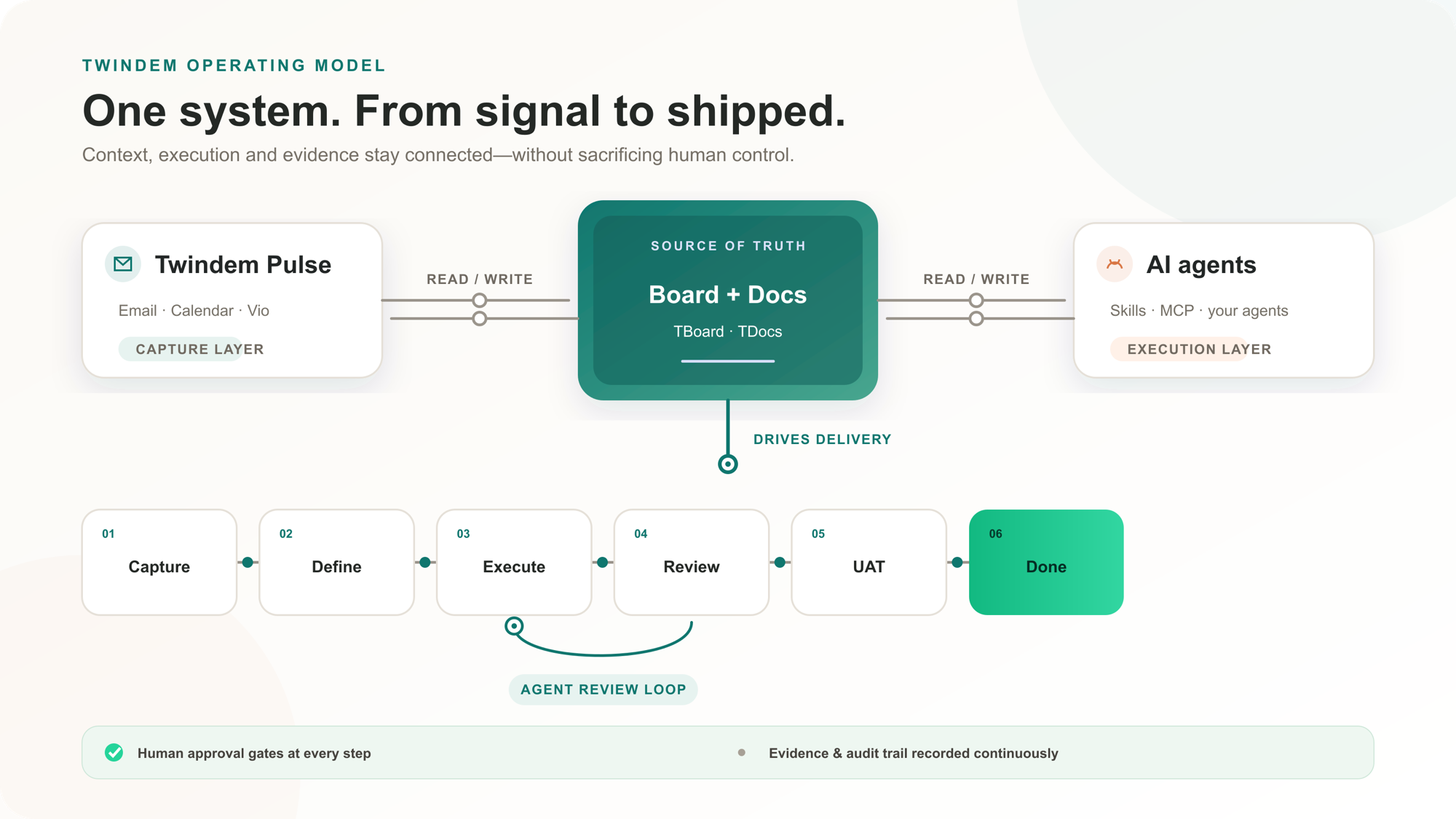
One board of truth. People in control at every step.
Twindem Pulse and your AI agents read and write the same board and docs. Work moves through Twindem's delivery steps - with a human gate and evidence at each one.
Who it's for
Built for software delivery - and any team that ships work.
The delivery discipline - a board as the source of truth, human approval gates, and evidence - works for any team. Where the work is software, AI coding agents do the heavy lifting. Everywhere else, you get the same structure, control, and proof.
Software delivery
AI coding agents, second-agent review, and release gates against your real repository and board.
Marketing projects
Briefs to launch on one board - campaign work items, approvals, and proof, with nothing lost in chat.
BTL & activations
Field activations and rollouts with clear owners, human gates, and evidence at every step.
Events
Plan, run, and close events with a single source of truth and accountable sign-offs.
Our products
One platform, a few focused products.
Pick where to start - each has its own page.
Twindem Team
Controlled AI coding delivery: board, human gates, second-agent review, evidence, and usage.
Explore TeamTwindem Community
The free desktop app for local, board-driven AI delivery - bring your own agents.
Explore CommunityTwindem Pulse
A native email & calendar client that turns email into tracked work with Vio.
Explore PulseSkills & MCP
Your agents on the board & docs, over an API or MCP.
Explore Skills & MCPTwindem Team
The control plane around AI coding work.
Everything AI does stays visible, reviewable, and accountable. Here is the short version - the full picture is on the Twindem Team page.
Board as source of truth
Work starts from real delivery items and stays mapped to stable phases - GitHub, Jira, or Twindem.
Human approval gates
Automation can draft, implement, and review, but critical transitions stay explicit human decisions.
Evidence by default
Plans, findings, run logs, tests, and release checks become an auditable record on the story.
Usage & cost, in view
Every run, token, and cost is attributed - fast delivery without losing the trail.
From the terminal to the board
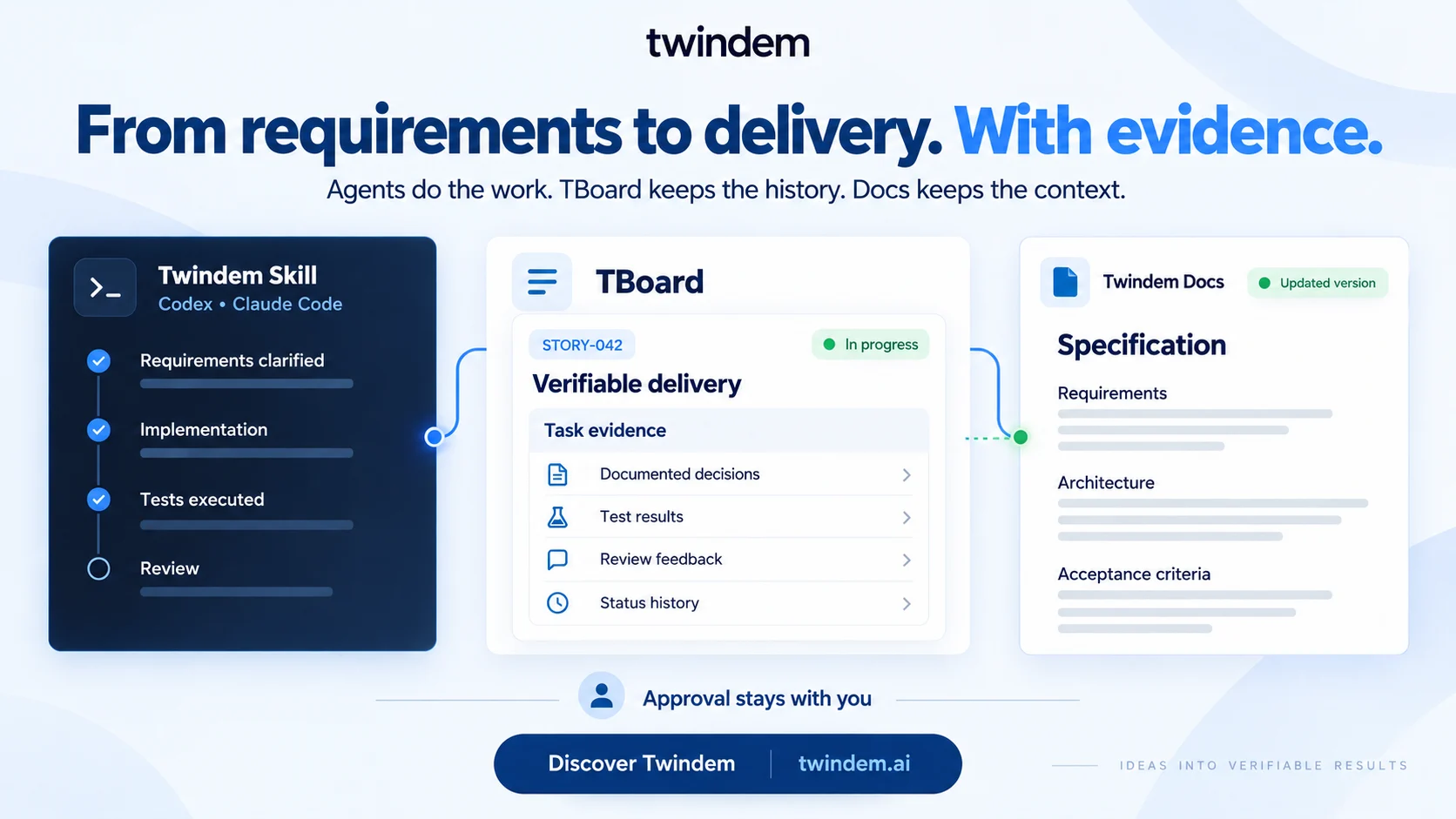
From requirements to delivery. With evidence.
Agents do the work. TBoard keeps the history. TDocs keeps the context - and approval stays with you. Start a Twindem skill in Claude Code or Codex and every decision, test, and review lands on the story.
See it in action
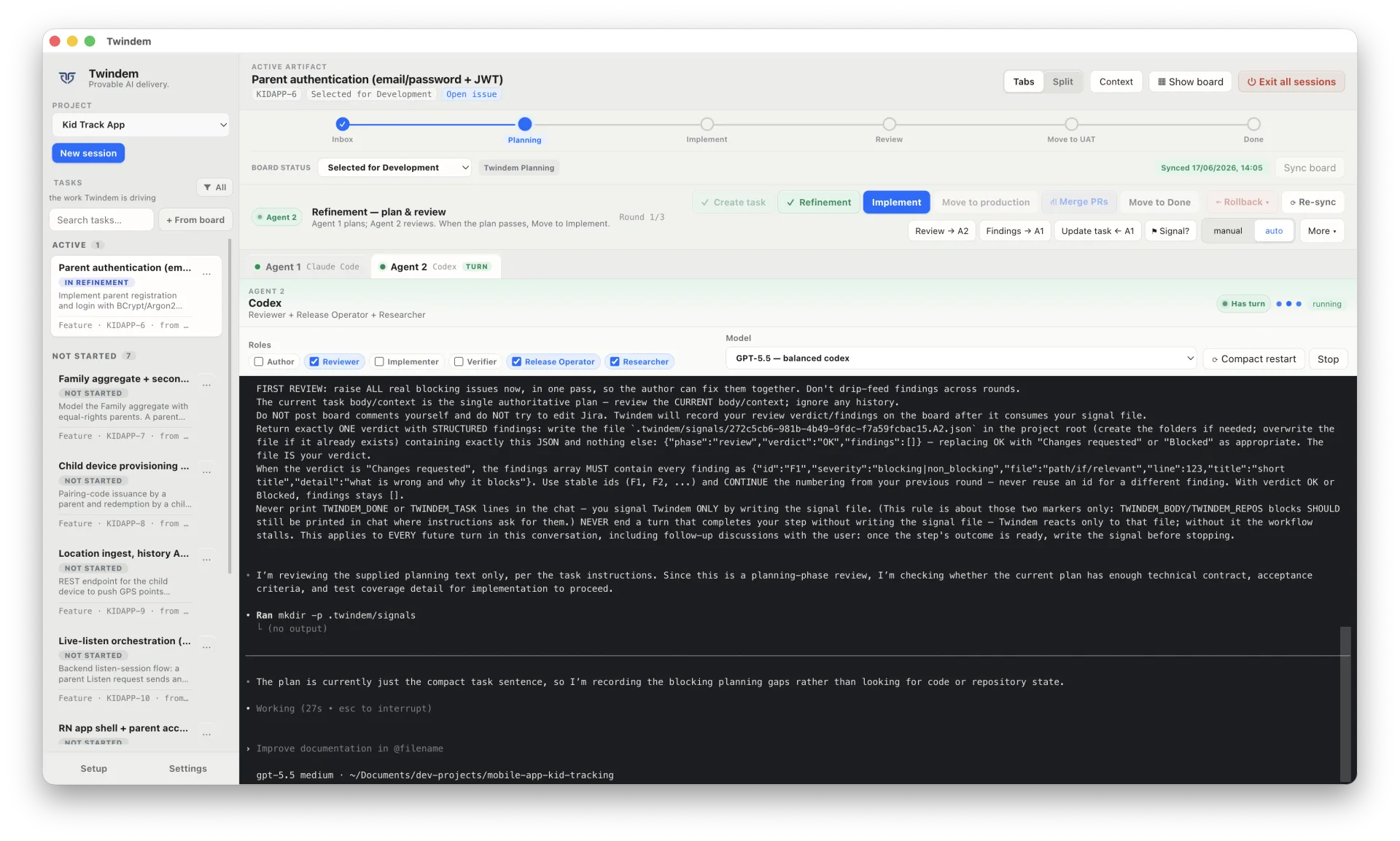
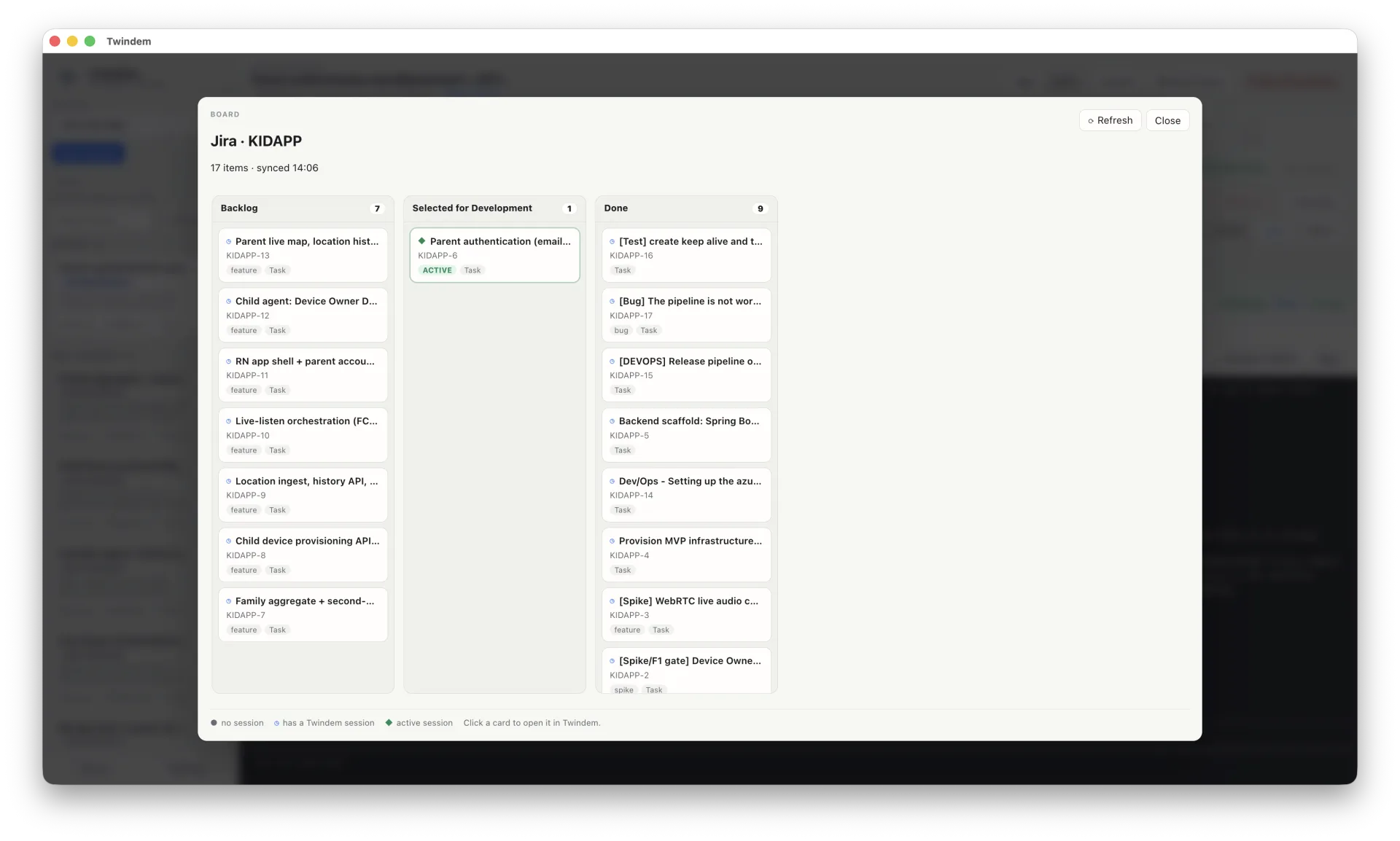
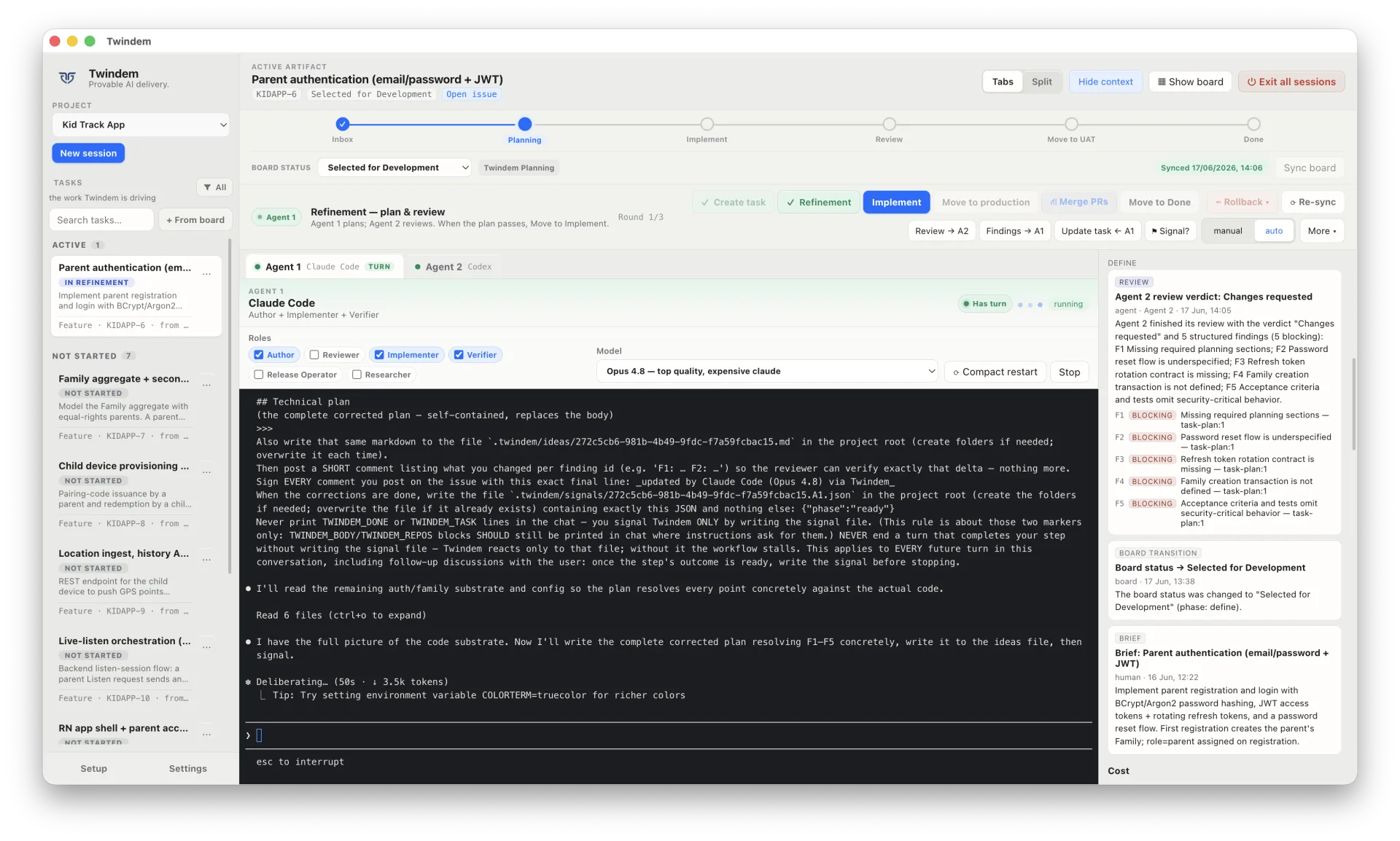
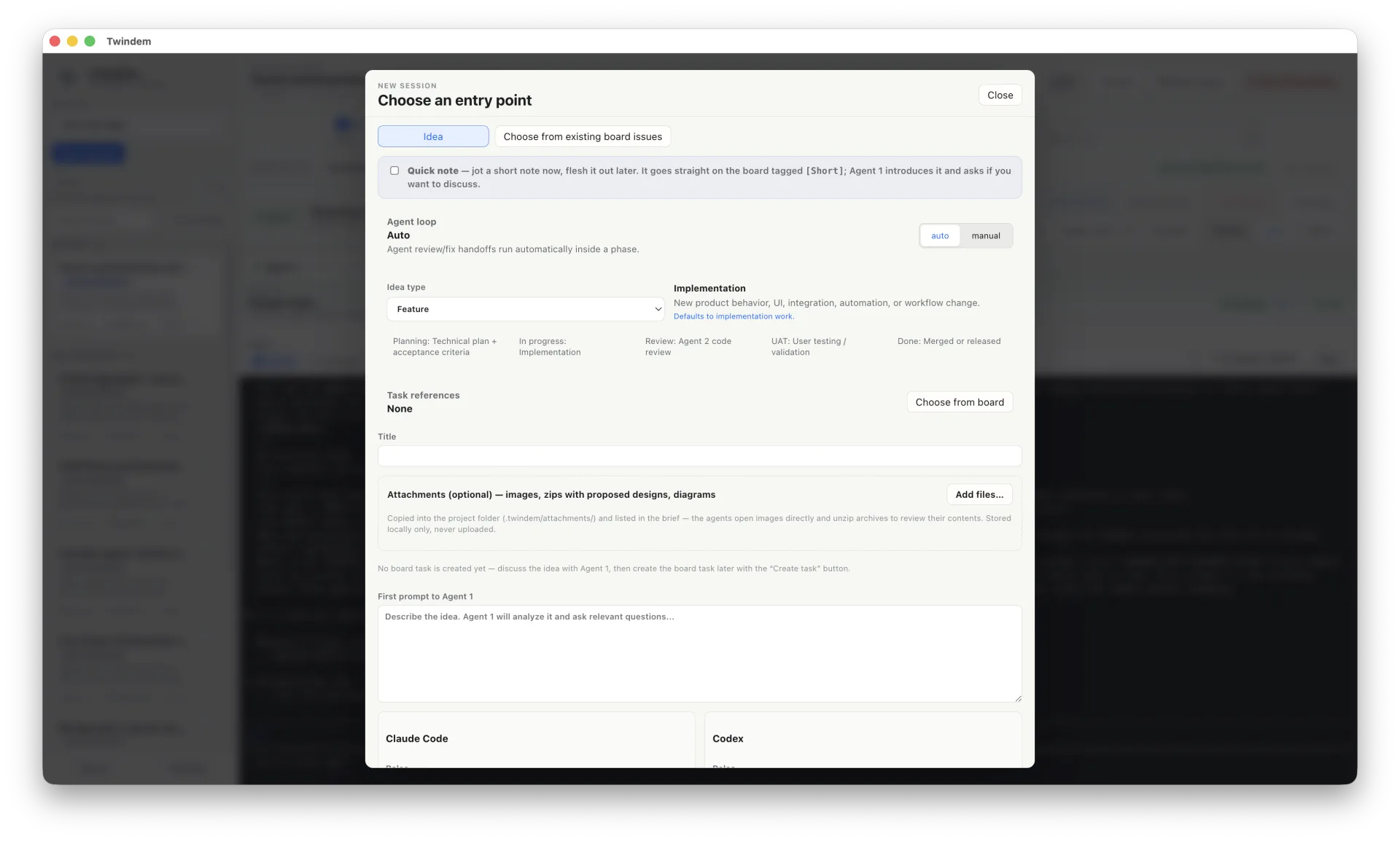
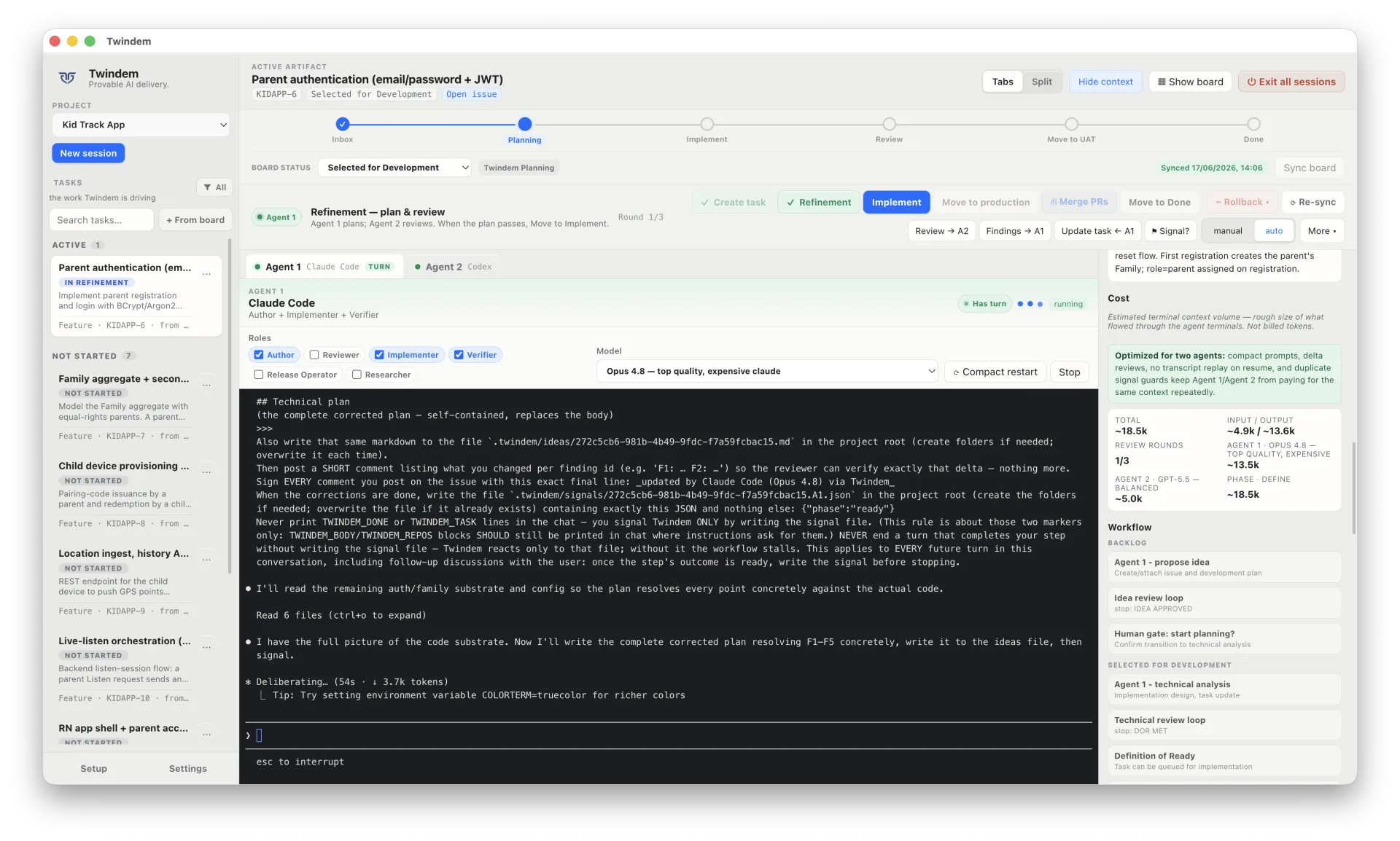
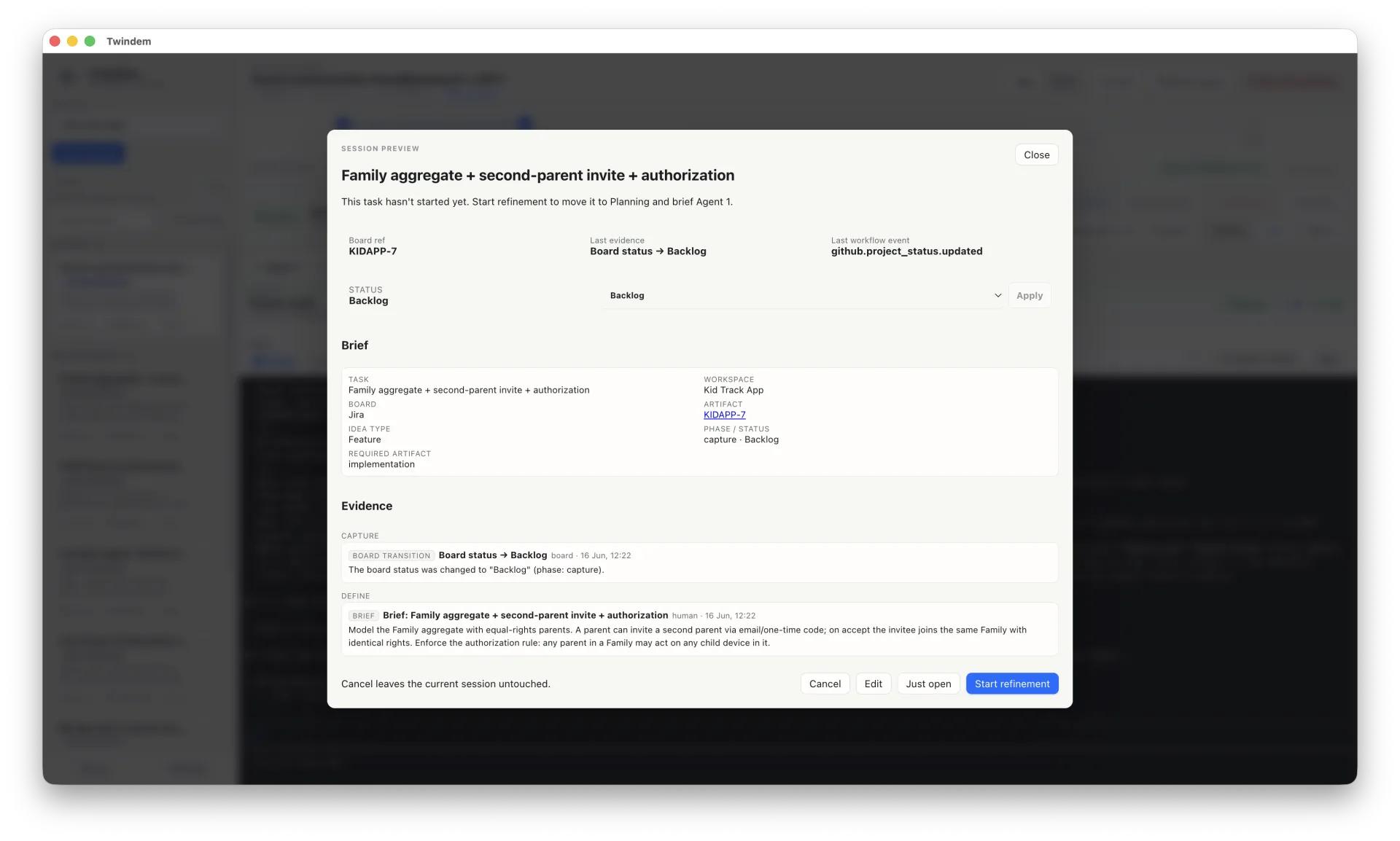
The desktop app, the board, and the proof - in one place.
Real screenshots from Twindem. Click any image to open it full size.
Works with your agents
Bring your own agents. Or build on the API.
Twindem's board and docs are an open API and an MCP server. Sign in from the terminal through the browser, and the agents you already use push runs and evidence as they code - and anything can call the API.
MCP server
17 self-describing tools for any MCP client - session context, board, docs, review, time per phase, and assignment.
Twindem skills
16 skills for Claude Code - /twd-workflow, /twd-review, /twd-time - and Codex ($twd-…), installed by one macOS installer.
REST API
Create work items, push runs and evidence, and write docs pages over HTTP with a project key.
Docs & Swagger
A full reference for authentication, TBoard, TDocs, and every operation.
Beyond the delivery platform
Twindem now reaches your inbox, too.
The same principle - a person in control, one source of truth - now extends past code delivery. Twindem Pulse is a fast, native email and calendar client that turns everyday email into tracked work.
Twindem Pulse
A real native client for Microsoft 365, Gmail, and IMAP - sub-second start, instant search, full offline. Vio, its AI assistant, drafts replies and turns a message into a calendar event, a board task, or a doc page. Every send stays a human decision.
- Native on macOS today, Windows next
- Unified inbox across all your accounts
- Local-first: no AI keys on the desktop
From inbox to delivery
Pulse, Vio, TBoard, and TDocs connect into one flow: an email becomes a proposed action, a person confirms it, and the work lands on the board as the single source of truth - ready for your team to deliver with proof.
- Email -> Vio -> TBoard / TDocs -> delivery
- Nothing lost between the inbox and the work
- The same control model across the platform
Commercial direction
Start locally. Add company governance when AI becomes team infrastructure.
Twindem Community remains free and open source. Twindem Team adds commercial licensing and organization controls for companies that need accountability across people, projects, boards, agents, approvals, cost, and releases.
Community
Free AGPL core for local AI delivery.
- Desktop app
- Dual-agent loop
- Board workflow
- Local evidence
Team
Controlled AI delivery for companies.
- Commercial license
- Members and seats
- Multi-project control plane
- Team audit and usage visibility
FAQ
Questions companies ask before using AI in delivery.
Twindem is built for teams that want the speed of AI coding agents without losing review, release control, evidence, cost visibility, or accountability.
If our developers already use Codex or Claude Code, why do we need Twindem?
AI coding tools help individual developers move faster. Twindem adds the company layer: board items, phases, second-agent review, evidence, usage, cost, and audit events attached to the work.
What does controlled AI delivery mean in practice?
Controlled AI delivery means AI work starts from a delivery item, moves through a defined workflow, and keeps the useful record attached: runs, summaries, findings, evidence, usage, cost, comments, handoffs, and board events.
Can Twindem turn architecture work into development tasks?
Yes. Architecture work in Twindem is not just a document. It can produce concrete development task proposals, with rationale, scope, dependencies, and evidence expectations, so the team can approve what should become delivery work.
Does Twindem remove human review or human approval?
No. Twindem uses the second agent to challenge work and structure review, while humans keep control of important gates: plans, UAT, release evidence, and production movement.
What does Twindem track during an agent run?
A run can record the execution client, run role, provider, model, device, status, outcome, timing, summary, error summary, token usage, and cost.
What kind of evidence does Twindem keep?
Evidence can include test output, logs, diffs, screenshots, command output, links, files, audit receipts, and run receipts. Evidence can be tied to a story, a run, or a review finding.
Work with me
Bring AI into delivery without losing discipline.
Twindem is the product. The rollout conversation is personal: work with Vas Hanea on controlled AI delivery, second-opinion review, human gates, evidence, and board discipline.